
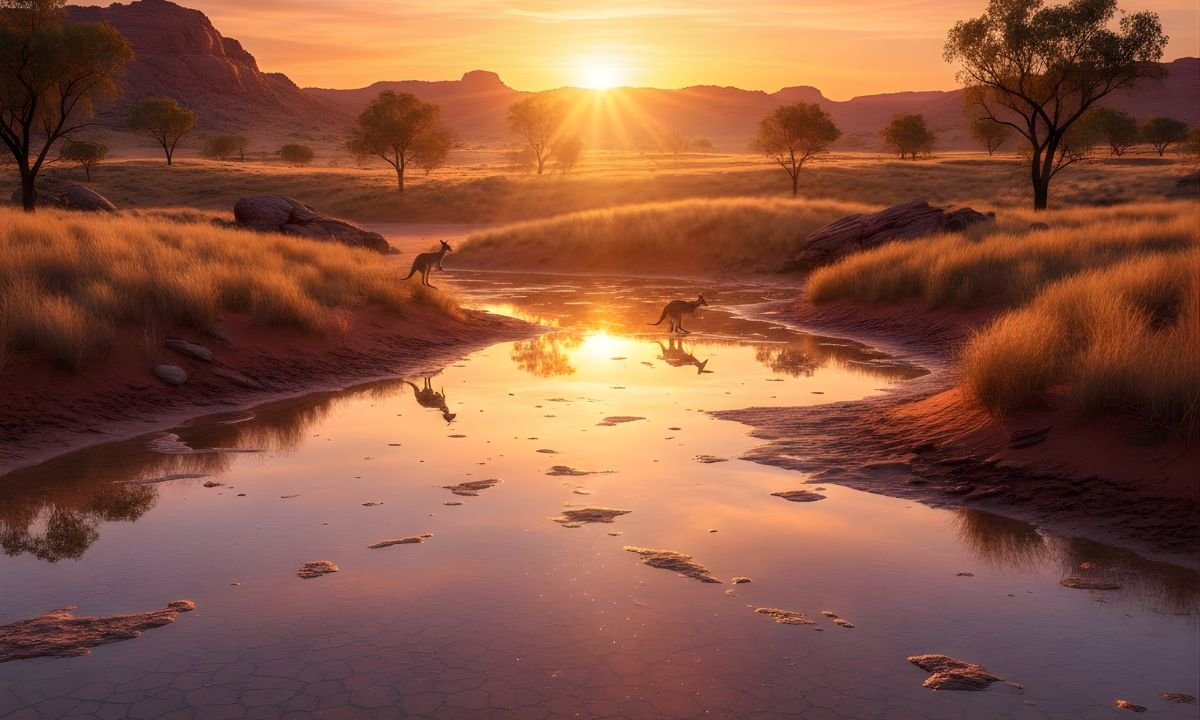

The Australian Outback at golden hour feels like another planet: colours deepen, shadows stretch for kilometres, and the desert turns into a living, glowing canvas of red, gold, and violet light.
Why Golden Hour Transforms the Outback
Golden hour in the Outback is the brief window after sunrise and before sunset when the sun sits low on the horizon and its light passes through more of the atmosphere, softening shadows and warming every colour it touches. The iron-rich soils and rocky plateaus respond dramatically, shifting from dull daytime browns to intense ochres, rust reds, and deep maroons that seem to pulse with heat and history.
Because the air is typically dry and clear, sunlight scatters less than in humid climates, so the colour contrast is crisper and the gradients in the sky—from orange to pink to indigo—appear more defined. Long, low shadows from spinifex grass, eucalyptus trees, and termite mounds add texture to otherwise flat plains, making even simple scenes look cinematic and three‑dimensional.
Iconic Desert Landscapes at Dusk
Across Western Australia’s vast interior, regions like Mount Augustus, the Kennedy Ranges, and the Goldfields transform at day’s end into some of the most striking desert panoramas on earth. The rocky ridges catch the final light first, glowing like embers while the valleys fall into cool blue shadow, creating a natural spotlight effect that guides your eye across the landscape.
Closer to the southern coast, the contrast becomes even more surreal: you can watch the red inland plains fade into pastel skies while, hundreds of kilometres away, white‑sand beaches around Esperance begin to blush pink under the same sunset. Whether you are driving a remote track or standing on a lookout, the sensation is of overwhelming scale and silence—a reminder of just how old and undisturbed these desert environments are.
Light, Colour and Atmosphere in Numbers
To appreciate the Outback’s golden hour more deeply, it helps to look at some practical data that affects what you will actually see and photograph.
These conditions combine to create a uniquely intense light profile: even modest ridges, dry creek beds, and stony plains can look like fine‑art landscapes when viewed within this short window.
Safe and Respectful Outback Experience
Experiencing the Outback’s desert landscapes at golden hour is unforgettable, but it demands preparation and respect for safety. Distances between towns are vast, fuel stops are limited, and mobile coverage can be patchy, so travellers should carry extra water, let someone know their route, and avoid driving at dusk where wildlife collisions are common. Temperatures can drop quickly after sunset even after a very hot day, so appropriate clothing and a basic first‑aid kit are essential for any sunset hike or roadside stop.
It is equally important to respect local culture and fragile ecosystems. Many of the most photogenic sites sit on or near Aboriginal lands where stories, rock art, and ceremonial places are part of a living heritage that should be approached with care and permission where required. Keeping to marked tracks, not disturbing wildlife, and following local guidance ensures that the same pristine desert vistas—uncluttered by litter or damage—remain for future visitors and for the communities that have called this country home for generations.
Photography Tips for Golden Hour Landscapes
For travellers keen to capture the Outback’s golden hour deserts, a few practical techniques can make the difference between flat snapshots and images that convey the true atmosphere. Shooting during the first and last 15 minutes of golden hour, when the light is at its warmest and shadows at their longest, brings out the sculpted texture of dunes, rocky outcrops, and dry riverbeds. Positioning yourself so the sun falls from the side—rather than directly in front or behind—adds depth and definition to every ridge and clump of grass.
Simple foreground elements like a lone tree, a termite mound, or a line of tyre tracks give scale to vast horizons and help viewers imagine themselves inside the scene. Because conditions can change quickly, from clear skies to glowing cloud banks, having a tripod ready, spare batteries, and dust protection for lenses ensures you can keep shooting safely as the light fades into the soft blue of early night.
Why These Deserts Keep Calling
What keeps travellers returning to the Australian Outback is not just the spectacle of one sunset, but the sense that no two golden hours are ever the same. The interplay of dust, cloud, temperature, and angle of light means that a familiar lookout in the Goldfields or along the Golden Quest Discovery Trail can reveal an entirely new character from one evening to the next. Some nights the sky steals the show with flaming oranges and purple streaks; on others, the land itself glows so intensely that the horizon looks like a slow‑burning fire.
In an age of constant noise and screens, standing on a remote track as the desert cools and the colours slowly drain from the land offers a rare moment of stillness and perspective. For many visitors, that combination of raw beauty, deep time, and quiet is what makes the Australian Outback at golden hour feel like one of the most beautiful and emotionally powerful desert landscapes on the planet.
